Find the Pleiades Open Cluster with the Naked Eye and Binoculars This Autumn
Key Takeaway
Follow the line from Orion's Belt through Aldebaran in Taurus to find the Pleiades cluster in the eastern sky on late autumn evenings.
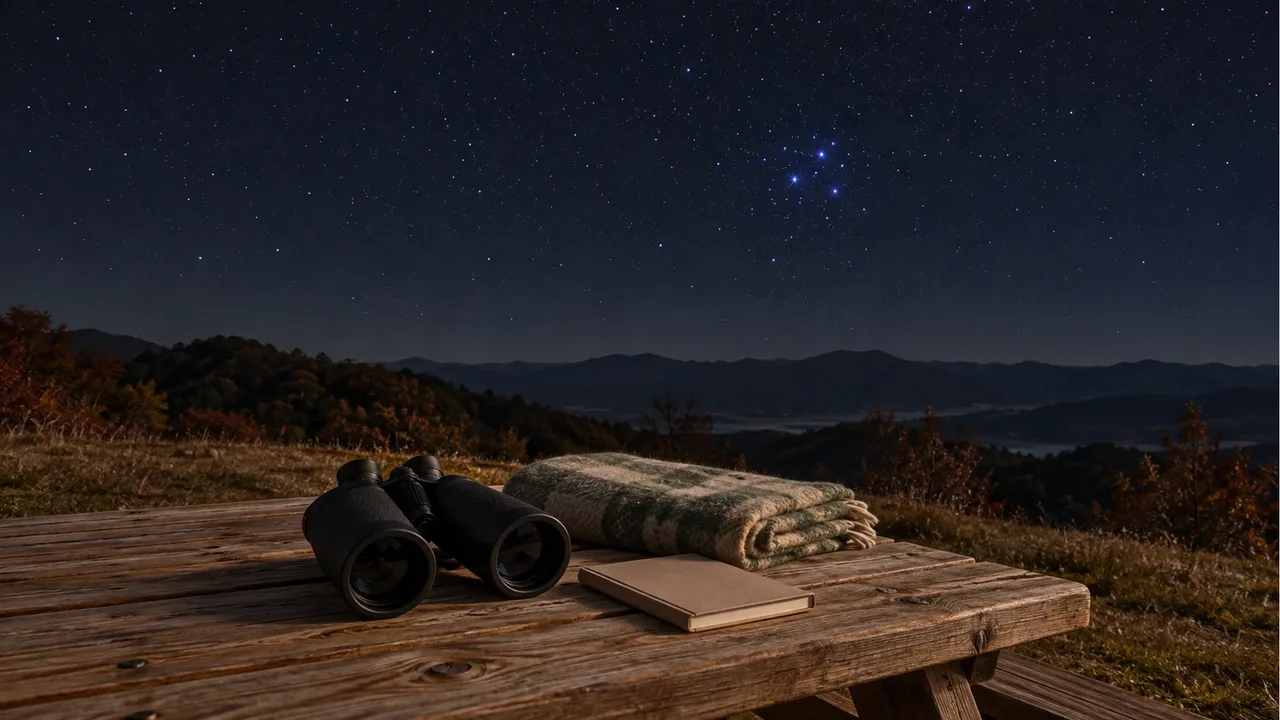
In 2026, the best window runs from October 31 to around November 13, when the Moon is out of the early evening sky.
This guide outlines what the cluster is, when to go out in late autumn 2026, how to locate it in the sky, observing tips for naked eyes and binoculars, and ways to handle city light.
What is the Pleiades star cluster?
Numbered 45 in the Messier catalog, it is widely known as M45, and traditionally in Korea it is called Jomsangibyeol. According to the NASA Hubble Messier Catalog, it lies approximately 445 light-years from Earth and is a relatively young open star cluster formed roughly 100 million years ago.
The entire cluster has an apparent magnitude of 1.6, making it one of the brightest deep-sky objects in the night sky. From a dark suburban site, your naked eye can clearly spot a small dipper-shaped group of blue stars, and binoculars reveal dozens of jewel-like blue stars scattered across the field of view.
When should I look for it in late autumn 2026?
NASA skywatching materials advise picking a moonless or near-new-moon night to observe star clusters clearly. Around 8 p.m. in late autumn, the cluster climbs well above the eastern horizon into a comfortable viewing altitude.
Based on the Korea Astronomy and Space Science Institute monthly astronomical table, here are the evening conditions free of moonlight.
| Date (day) | Sunset | Moon | Sky at 9 p.m. |
|---|---|---|---|
| Oct 26 (Mon) | 17:41 | Full Moon at 13:12, rises 17:23 | Bright full Moon all night |
| Oct 31 (Sat) | 17:35 | Rises 22:03 | Dark with no Moon until 22:00 |
| Nov 3 (Tue) | 17:32 | Rises 00:29 | Moonless night sky until midnight |
| Nov 9 (Mon) | 17:26 | New Moon at 16:02, sets 17:00 | No Moon all night, optimal |
| Nov 13 (Fri) | 17:23 | Sets 20:01 | Dark after 20:00 moonset |
Checked on 2026-10-26 against the Korea Astronomy and Space Science Institute monthly table. Times can vary by a few minutes depending on location.
The week from November 2 to November 8 is the most convenient for early evening viewing because the Moon rises late at night or after midnight.
How do I locate the cluster in the night sky?
Following NASA's star-hopping path makes it easy even for beginners.
- Look toward the east to southeast around 8 to 9 p.m. in late autumn.
- First locate the three bright stars in a row that form the belt of Orion, the signature winter constellation.
- Extend an imaginary line through the belt stars up and to the right (northwest).
- You will pass the bright orange first-magnitude star Aldebaran and the V-shaped Hyades cluster in Taurus.
- Continuing a short distance in the same direction brings you straight to the tight bluish bunch of the Pleiades.
If Orion is still low, you can also trace downward from Cassiopeia and Perseus in the northeastern sky to find it.
What does it look like to the naked eye and in binoculars?
When viewing with the unaided eye, use averted vision by looking 10 to 15 degrees to the side rather than staring straight at the cluster. The outer edges of your retina contain more rod cells sensitive to dim light, making faint hidden stars suddenly pop into view.
For binoculars, a 40 mm to 50 mm objective lens with 7x to 10x magnification (such as 7x50 or 8x42) works best. The Pleiades spans roughly 2 degrees across the sky, so wide-field binoculars let you take in the entire cluster of glittering blue stars in one view far better than a narrow-field telescope.
Pre-focus your binoculars on a distant streetlight or building before heading out. Trying to adjust the focus wheel outside in cold weather makes your hands stiff and leads to shaky views.
What if I am in the city or the Moon is bright?
Move to a shaded spot where direct glare from streetlights or apartment complexes is blocked from your sightline. At magnitude 1.6, the Pleiades is bright enough that blocking direct glare lets you spot 4 to 5 stars even from an urban park or rooftop.
However, to see the faint blue reflection nebulosity enshrouding the cluster and dozens of pinpoint stars, visiting a dark sky site with low light pollution is best. Detailed steps for checking light pollution levels can be found in Find a Good Stargazing Spot Using Light Pollution Maps and the Bortle Scale.
Late autumn nights are colder than expected, and wind chills can drop fast. Pack a warm insulated jacket, gloves, and a hot beverage, and check that evening's moonset time in the astronomical calendar before you set out.
Frequently Asked Questions
How many stars can I see with the naked eye?
According to the NASA Hubble Messier Catalog, a person with average eyesight looking under a dark sky can see 6 to 7 stars clustered together. In Korea, this grouping has traditionally been called Jomsangibyeol, while ancient Greek mythology knows them as the Seven Sisters.
Are binoculars better than a telescope for this?
Yes. The Pleiades spans roughly 2 degrees across the sky, which is more than three times the apparent width of the full Moon. High-magnification telescopes show only a handful of stars at a time, whereas wide-field binoculars bring dozens of sparkling blue stars into a single panoramic view.
Can I look for it on the night of the full Moon on October 26?
It is not recommended. On October 26, the full Moon shines brightly across the sky all night, washing out the fainter starlight of the cluster. Choose an evening after October 31 when the Moon rises after 22:00, or during the first week of November when it rises after midnight.
Sources & Verification Date
- NASA Hubble Messier Catalog: Messier 45 · Verified
- Korea Astronomy and Space Science Institute: monthly astronomical events (October and November 2026) · Verified
- NASA Skywatching: observing star clusters in the autumn sky · Verified
All materials have been verified from official announcements and may have changed since verification.