Use Light Pollution Maps and the Bortle Scale to Find Stargazing Spots
Key Takeaway
When picking a stargazing spot, check the 9-class Bortle scale and light pollution maps. For inland Korea, aim for Class 3 to 4 skies after moonset. Below are class breakdowns and steps to read maps.
What Criteria Define the Bortle Scale?
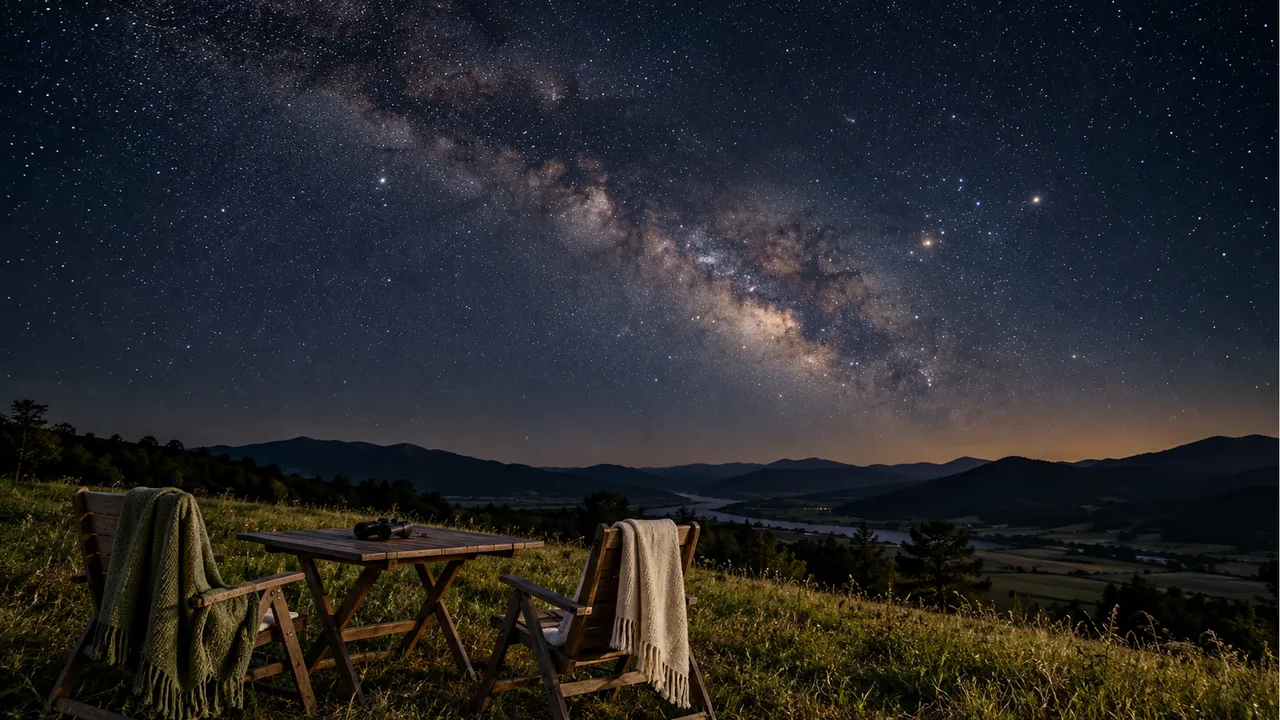
The Bortle scale introduced by DarkSky International rates night sky darkness and artificial light interference across nine distinct levels, from Class 1 (an exquisitely dark sky) to Class 9 (inner-city sky). It uses naked-eye limiting magnitude (NELM), the visibility of the Milky Way, and the degree of surrounding ground darkness as key metrics. Lower numbers mean darker skies without artificial interference, while higher numbers indicate severe urban light washing out the stars.
Astronomical observation requires more than simply stepping away from a street lamp; you must gauge how much horizon glow spreads from surrounding towns. The Bortle scale offers a reliable standard to assess visual conditions right at your site.
How Does the Night Sky Look in Each Class?
Here is a summary of typical sky conditions and key observational features across the Bortle classes.
| Bortle Class | Sky Quality | Key Observational Features | Naked-Eye Limiting Magnitude |
|---|---|---|---|
| Class 1–2 | Truly dark to typical dark sky | Intricate Milky Way structures and nebulae stand out sharp; zero horizon glow | Around 7.0 to 8.0 mag |
| Class 3–4 | Rural sky to rural/suburban transition | Summer and winter Milky Way bands appear distinct; faint light lingers on the horizon | Around 6.0 to 6.5 mag |
| Class 5–6 | Suburban to bright suburban sky | The Milky Way is only faintly visible overhead; city glare washes out lower horizons | Around 5.5 to 6.0 mag |
| Class 7 | Suburban/urban transition | The entire sky takes on a grayish tint; the Milky Way is virtually undetectable | Around 5.0 mag |
| Class 8–9 | City to inner-city sky | Only the Moon, bright planets, and a few first-magnitude stars show; constellations are hard to trace | Around 4.0 to 4.5 mag or worse |
Verified on October 25, 2026. Source: DarkSky International Bortle Scale guidelines.
Mountainous interior areas in South Korea generally fall within Class 3 to Class 4. Under clear, moonless skies, these zones still allow you to enjoy broad sweeps of the Milky Way with the naked eye.
How Do You Read a Light Pollution Map?
National portals such as the Good Light Information Center and global satellite maps display night-time surface illumination using color-coded overlays. Follow these steps when picking a location.
- Locate areas highlighted in dark blue or green on the satellite overlay.
- Check whether major metropolitan centers lie in your primary viewing direction, especially toward the south or overhead.
- Inspect the immediate surroundings, as nearby roadside lamps, sports facilities, or greenhouse clusters can make the spot brighter than the map indicates.
Rather than relying purely on colors, always verify what lies beyond the northern or southern horizon. Metropolitan glare from large urban areas can brighten horizon skies tens of kilometers away.
What Should You Check Before Heading Out?
Even if you find a low-pollution location, poor conditions on your observation night will spoil the trip.
- Moon phase and moonset time: The night sky brightens noticeably around the full moon. Consult astronomical calendars to pick hours after the Moon has dipped below the horizon.
- Cloud cover forecast: Even scattered cloud cover reflects ambient ground illumination, rapidly washing out faint stars.
- Cold-weather gear and safety lights: Rural observation spots drop significantly in temperature after dark. Pack layered outerwear and use red-filtered flashlights to protect your night vision.
Checking weather reports and planning a safe return route before departure is just as essential as locating an unpolluted sky.
Frequently Asked Questions
Can I see any stars from the middle of a big city?
Even in inner-city skies rated Bortle Class 8 to 9, bright targets like the Moon, Jupiter, Saturn, and first-magnitude stars remain visible. You must travel further out to spot faint nebulae, the Milky Way, or dimmer constellations.
Does a green or blue zone on a light pollution map guarantee a visible Milky Way?
Even if the mapped light level is ideal, overcast skies or bright moonlight will block the Milky Way. Always check the local cloud cover and moonset times before heading out.
Can you find a true Class 1 dark sky in South Korea?
According to DarkSky International standards, Class 1 requires total darkness with zero artificial light along the entire horizon. In mainland Korea, where cities are dense, Class 1 is virtually unreachable; remote mountainous areas in Gangwon or northern Gyeongbuk at Class 3 to 4 represent the most practical target.
Sources & Verification Date
- DarkSky International: What Is Light Pollution and Measuring Standards · Verified
- National Institute of Environmental Research Good Light Information Center · Verified
- Korea Astronomy and Space Science Institute Monthly Astronomical Phenomena for October 2026 · Verified
All materials have been verified from official announcements and may have changed since verification.