Check What Time to Start Watching the 2026 Geminid Meteor Shower on December 14
Key Takeaway
KASI's table lists the Geminid peak at 23:00 on Monday, December 14 (IMO basis). The Moon sets at 21:52 that day, so you can watch around the peak under a sky with no moonlight.
As of October 19, the shower is still nearly two months away.
When can you see it?
The Korea Astronomy and Space Science Institute (KASI) monthly table for December lists the Geminid peak (ZHR=150, IMO basis) at 23:00 on December 14. That is nighttime in Korea, so you can watch the peak as it happens.
NASA gives the 2026 active period as December 4 to 17 and the peak as December 13 to 14. It says the shower is visible through the night and the predawn hours, lasting until dawn.
How much does moonlight matter?
New Moon is at 09:52 on December 9, so around the peak the Moon is a thin crescent. Once it sets in the west in the evening, the sky turns dark.
| Night | Moonset | Next sunrise | Notes |
|---|---|---|---|
| Night of Dec 13 (Sun) | 20:52 on the 13th | 07:39 on the 14th | NASA peak Dec 13–14 |
| Night of Dec 14 (Mon) | 21:52 on the 14th | 07:39 on the 15th | Peak at 23:00 (IMO basis) |
| Night of Dec 15 (Tue) | 22:52 on the 15th | 07:40 on the 16th | NASA active until the 17th |
Checked 2026-10-17; source: KASI monthly astronomical events. The peak time, moonset and sunrise times come from the date cells of the same table.
On both the 13th and the 14th, the Moon sets around 9 p.m., leaving close to ten hours of dark sky until about 7:30 the next morning.
How many will you see?
The numbers from the two sources mean different things.
- KASI's table gives a ZHR of 150.
- NASA says to expect 40 to 50 per hour under dark skies.
- NASA also notes that up to 120 per hour can be seen at the peak under perfect conditions.
ZHR assumes an ideal sky, so the real count is lower. Even so, it is far more than the November Leonids (fewer than 3 per hour, per NASA).
NASA describes Geminid meteors as bright and fast, often yellowish. Their parent body is also unusual: the asteroid 3200 Phaethon rather than a comet.
Where and how should you look?
Here is NASA's advice in order.
- Get well away from city lights and street lights.
- Lie flat on your back with your feet facing south.
- Take in as much of the sky as you can.
- After about 30 minutes in the dark, your eyes adapt and meteors start to appear.
You do not need to stare at Gemini. NASA also says not to look only at the radiant constellation. Meteors can appear anywhere in the sky.
What should you bring?
It is a mid-December night outdoors, so staying warm matters most.
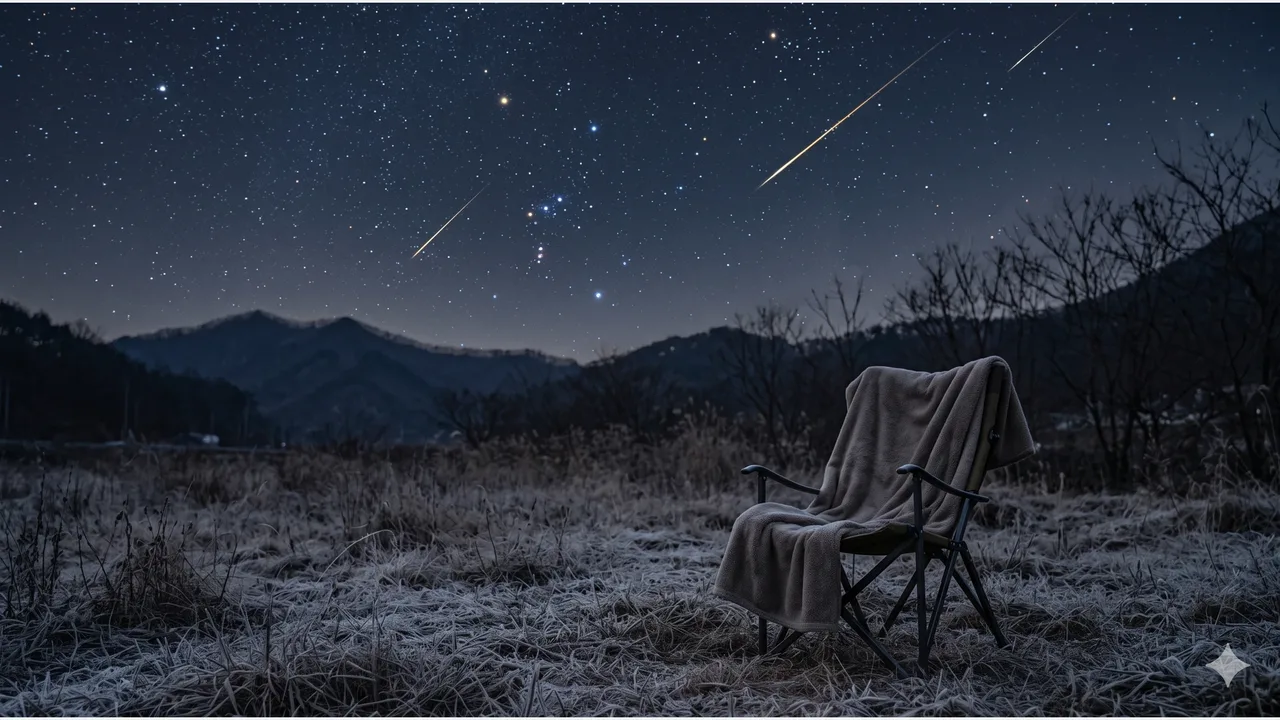
- Bring a sleeping bag or thick blanket and a folding chair.
- Turn your phone screen to its lowest brightness or switch to a red light.
- Check the Korea Meteorological Administration cloud forecast before you leave.
- Watch for car headlights on dark roads and set up away from the road.
What if the weather is bad?
NASA lists activity until December 17, so the nights of the 13th and 15th are also options. According to the table, the Moon sets before 23:00 through the night of the 15th, keeping the late-night sky dark. If it is cloudy, wait a day or two for a clear night, and check that day's moonset time once more before you go.
Frequently Asked Questions
Can I see them if I go out at 9 p.m.?
NASA says the Geminids start around 9 or 10 p.m. On the 14th, though, the Moon sets at 21:52, so to watch without moonlight it is better to go out after that.
Will I see 150 meteors an hour?
The 150 is the ZHR value in KASI's table. NASA says to expect 40 to 50 per hour under dark skies. Near a city you will see fewer than that.
How should I prepare for the cold?
NASA suggests bringing a sleeping bag or blanket and a lawn chair. It is a midwinter night, so lying still for a long time chills you quickly. On dark rural roads, cars can appear suddenly, so pick a spot away from the road.
Sources & Verification Date
- Korea Astronomy and Space Science Institute (KASI) monthly astronomical events, December 2026 · Verified
- NASA guide to the Geminid meteor shower · Verified
All materials have been verified from official announcements and may have changed since verification.